The TAMS grant for solar panels still pays the better headline rate at 60%, but the SEAI grant, now lifted to an effective 45%, is the one most farms can realistically secure. That is the whole decision in a sentence.
Since 6 October 2026, the Non-Domestic Microgen Grant (NDMG) has paid an effective 45% of eligible costs instead of roughly 23%. Farms sit squarely inside the eligible group. Meanwhile, the Solar Capital Investment Scheme under TAMS 3 has been squeezed by ranking and selection, and around nine in ten solar applications are now turned away.
So the comparison that matters is not 60% against 45%. It is 60% you probably will not get against 45% you almost certainly will, inside a window that closes in July 2027.
Which Pays More for Farm Solar, the TAMS Grant for Solar Panels or the 45% SEAI Rate?
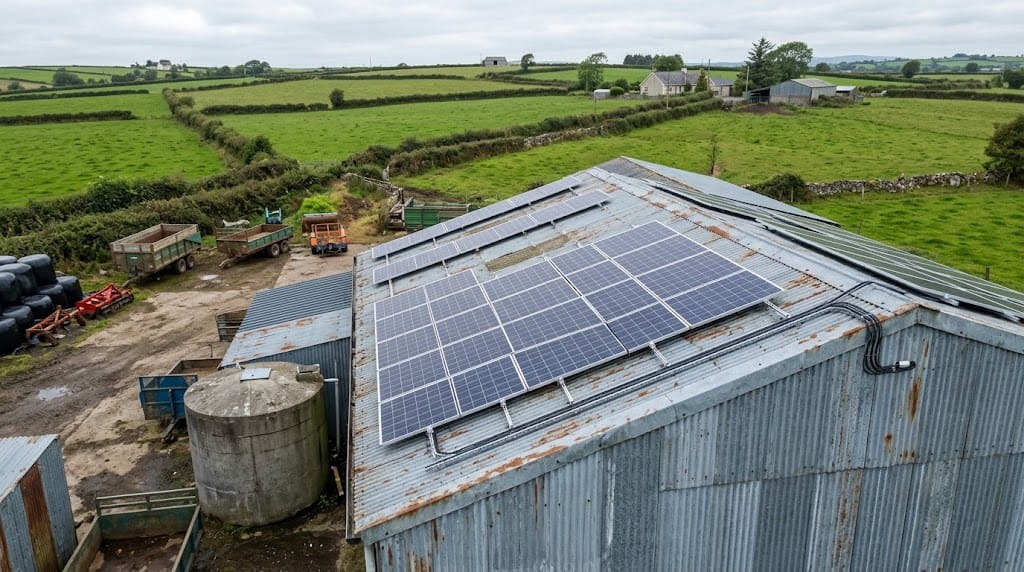
TAMS pays more per euro spent, at 60% of approved costs up to a ring-fenced €90,000 ceiling, which works out at a maximum grant of €54,000. The enhanced SEAI route pays less per euro but has no tranche, no ranking and no queue.
| TAMS 3 Solar Capital Investment Scheme | SEAI Non-Domestic Microgen Grant | |
| Administered by | Department of Agriculture, Food and the Marine | SEAI |
| Grant rate | 60% of approved reference costs | Effective 45%, paid as the lower of the band value or 45% of the invoiced cost |
| Ceiling | €90,000 investment ceiling, so up to €54,000 | €325,200 maximum grant |
| Maximum system size | 62 kWp | 1,000 kWp |
| Battery storage | Grant-aided, capped at 50% of array capacity | Not an eligible cost |
| How you apply | Through agfood.ie in tranches, applications scored and ranked | Online through SEAI at any point in the window |
| Current deadline | Tranche 14 closes 4 December 2026 | New applications from 6 October 2026 to 6 July 2027 |
One more difference decides most cases. TAMS pays 60% of the Department’s reference costs rather than 60% of your actual quote, so the cash figure is often lower than farmers expect. The SEAI grant is measured against your real invoice.
What Changed in the SEAI Solar Grant on 6 October 2026
SEAI increased NDMG support to an effective 45% rate for a nine-month application window running from 6 October 2026 to 6 July 2027, as an action of the National Energy Affordability Taskforce. The per-kWp grant values roughly doubled, and the maximum grant rose to €325,200.
The scheme is open to businesses, the agricultural sector, schools, community centres, public sector bodies and non-profits, which is confirmed on the SEAI business grant page along with the full rate table. The payment you receive is the lower of two figures: the value on your application summary, or 45% of the invoiced cost.
For background on how the scheme works outside this window, our guide to the SEAI commercial solar grant covers the application process end to end.
Why TAMS Solar Approvals Have Become So Hard to Get
Demand outran the budget. Ranking and selection was introduced at tranche nine to control TAMS spending, and the Solar Capital Investment Scheme has been one of the hardest hit, with roughly 10% of solar applications selected in recent tranches.
Two changes tightened it further:
- Domestic dwellings were removed from the solar scheme at tranche 11, so the array is now sized on farm electricity demand alone. For many drystock and tillage farms, the dwelling was the demand that justified the system.
- Ranking favours trained young farmers under 40, female farmers and registered partnerships that include one. Everyone else is competing for what is left.
That does not make TAMS a waste of time. If you fall into a favoured ranking category and your on-farm demand supports a decent array, the TAMS 3 solar terms and conditions are still worth working through with your agricultural adviser before tranche 14 closes on 4 December 2026.
What the 45% SEAI Grant Is Worth on a Farm-Scale System

SEAI pays per kWp in stacked bands, and the bands land farm-scale systems between roughly €13,000 and €30,000. The catch is the 45% cap, so the full band value only comes through if your invoiced cost is high enough to support it.
| System size | NDMG grant value | Invoiced cost needed to receive it in full |
| 20 kWp | €13,200 | €29,333 |
| 30 kWp | €17,200 | €38,222 |
| 50 kWp | €25,200 | €56,000 |
| 62 kWp | €30,000 | €66,667 |
Read the right-hand column before you celebrate the middle one. A 30 kWp array quoted at €34,000 does not return €17,200, it returns €15,300, because 45% of the invoice is the binding number.
Sizing drives everything here, and the detail is set out further on our commercial solar grant page if you want to work through the numbers for your own roof area and demand.
Battery Storage Is the Gap the 45% Rate Does Not Fill
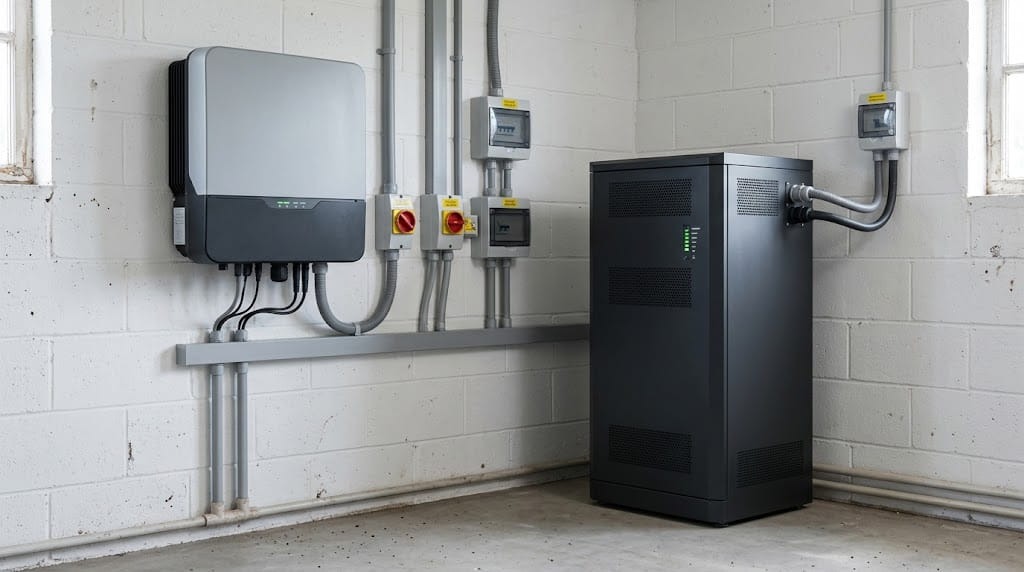
Batteries are not an eligible cost under the NDMG. TAMS grant-aided them at 60% up to half the capacity of the array, so for any farm that wanted storage, the enhanced SEAI rate is not a like-for-like replacement.
This matters most where load and generation do not line up. A dairy parlour running at milking times, or a tillage farm with grain drying in late summer, can use a high share of solar output directly. A drystock farm with low daytime demand gets far less from an unstored system.
Storage can still be installed, it simply sits outside the grant. Our solar for farms work usually starts with half-hourly consumption data rather than roof size, because that is what tells you whether a battery earns its place at full cost.
3 Rules That Catch Farmers Out on Both Schemes
- No grandfathering. Existing NDMG grant offers cannot be raised to the 45% rate, because state aid rules do not permit it. Anyone who has already started work under an older offer stays on that offer.
- No work before approval. Starting an installation before the letter of offer arrives disqualifies the application outright. Offers are valid for eight months from the date of issue.
- No double funding. The same installation cannot be funded twice from the State. You pick a route, you do not stack TAMS and the SEAI grant on one array.
Add one practical item to that list. Your installer must apply to ESB Networks before the system goes in, and that process takes at least 20 working days, so build it into the timeline rather than discovering it in week one.
How Accelerated Capital Allowance Stacks With a Solar Grant
Accelerated Capital Allowance (ACA) lets a farm business write off 100% of qualifying equipment cost against taxable profit in year one, instead of 12.5% a year over eight years. It is a tax measure, not a grant, so it works alongside whichever grant route you take.
Two conditions do the filtering. The equipment must be new and listed on SEAI’s Triple E register at the time of purchase, and it must be used for the trade. Revenue’s guidance on accelerated capital allowances for energy-efficient equipment confirms the scheme runs to 31 December 2030 and has applied to unincorporated businesses, including sole traders, since 2017.
The relief applies to the net spend after grant aid, so run the figure past your accountant rather than assuming the headline cost. On a farm paying tax at the higher marginal rate, it changes the payback period more than most people expect.
Choosing Between TAMS and the SEAI Route for Your Farm
Work it in this order. If you are a trained young farmer, a female farmer or in a registered partnership with one, apply to tranche 14 and treat the SEAI grant as your fallback. If you sit outside those categories, the nine-month window is the better use of your time, and waiting for a future tranche costs you the 45% rate.
Both schemes apply in the Republic of Ireland only. Farms in Northern Ireland fall outside them and should confirm available support locally before budgeting.
If you want the sizing, the grant paperwork and the ESB Networks application handled as one piece of work, talk to our team about your farm and we will set out the realistic figure for your site.