Most Irish businesses fitting solar want one number before anything else. How long until it pays for itself? For a commercial rooftop system in Ireland, the commercial solar payback period usually lands between 4-7 years, and an operation that runs its heavy loads during daylight can reach the lower end of that. After that, the electricity your panels produce is close to free for the remaining 20-plus years of the system’s life.
This post breaks down what actually moves the return on investment, how grants and tax relief shorten it, and how to work out a realistic figure for your own building.
How Long Does Commercial Solar Take to Pay for Itself?
Most commercial solar systems in Ireland pay for themselves within 4-7 years, and a business with strong daytime energy use can beat that.
The return on a commercial system comes from three places, and they carry very different weight.
- Bill savings from the solar power you use on site. This is the largest source of value for almost every business, because you avoid buying that electricity at your full grid rate.
- Export income for surplus power sent to the grid. Useful, but paid at a lower rate than you save by using power yourself.
- Tax relief through the Accelerated Capital Allowance, which lets a trading business write off the equipment cost against profits in the first year.
A cheaper system that generates little value pays back slowly, while a well-matched system on a daytime operation clears its cost quickly. That is why a single-quote figure tells you very little without a load profile beside it.
Why Daytime Usage Sets Your Payback Speed
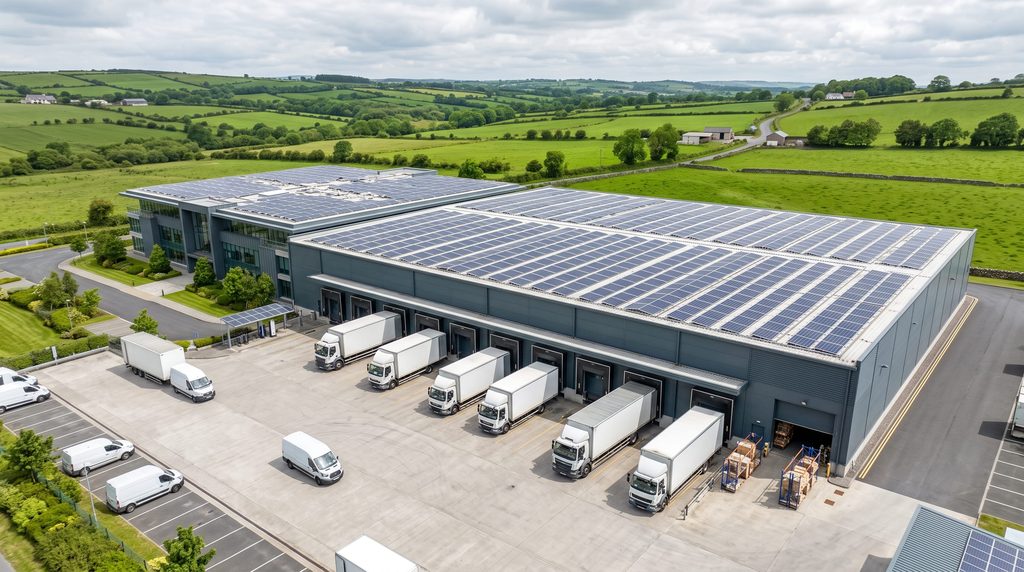
Solar generates most between roughly 9am and 5pm. A business that is busy in those hours, a factory, a warehouse, a cold store, a data facility, uses that power as it is made and avoids buying it. A building that sits quiet by day sends most of its generation to the grid for a smaller reward.
| Where a solar unit goes | What it is worth to a business | Direction of travel |
| Used on site during the day | The grid price you avoid, around €0.23 per unit ex VAT and often higher once all charges are counted | Rising as electricity prices climb |
| Exported to the grid | The export rate your supplier pays, under €0.20 per unit from most suppliers | Falling as suppliers cut export rates |
The practical takeaway is to size the array to your daytime baseline, not to fill every square metre of roof. This is exactly why solar for logistics and businesses pays back faster than the same panels on a building that empties out by mid-afternoon.
How SEAI Grants and Tax Relief Cut Years off the Payback
Grants and tax relief lower the net cost of a system, which shortens the payback directly. The SEAI Non-Domestic Microgen Grant covers up to €162,600, and the Accelerated Capital Allowance lets a qualifying business deduct the full equipment cost against profits in year one.
SEAI Non-Domestic Microgen Grant
The Non-Domestic Microgen Grant pays a tiered rate based on system size in kilowatt peak (kWp). Smaller systems earn a higher rate per kWp, and the rate steps down as the system scales.
- €300 per kWp for the portion from 7 to 20 kWp
- €200 per kWp for 21 to 200 kWp
- €150 per kWp for 201 to 1,000 kWp, up to the €162,600 ceiling
You can check the current rates and eligibility in the official guidance on the Non-Domestic Microgen Scheme, and the Letter of Offer must be in place before any work starts.
Accelerated Capital Allowance Tax Relief
The Accelerated Capital Allowance (ACA) lets a business claim 100% of qualifying energy-efficient equipment against taxable profits in the year of purchase, instead of spreading it over eight years. Solar PV listed on the SEAI Triple E register qualifies. On a €50,000 system, a company on the 12.5% trading rate could see around €6,250 back through reduced tax in year one.
You can read the government guidance on Accelerated Capital Allowances to confirm your business qualifies.
What Payback Looks Like Across Real System Sizes
Real installed sizes give a clearer picture than round examples. A rooftop array generates roughly 850 to 950 units per installed kWp each year in Ireland, so the system size tells you the ballpark generation before you model savings against your own tariff.
| Installed system size | Estimated yearly generation at Irish yields |
| 19 kW rooftop on a Dublin pub | around 16,000 to 18,000 units |
| 128.65 kWp rooftop on a Dublin distribution centre | around 109,000 to 122,000 units |
| 736 kWp array on a large Kildare facility | around 626,000 to 699,000 units |
Turn those units into money and the point about self-consumption sharpens. A distribution centre using most of 115,000 units on site at its own grid rate is avoiding a very large annual bill, which is why systems of that scale often clear their cost quickly.
After the SEAI grant tiers are applied, the net cost on a system this size drops again before any tax relief is counted.
How to Calculate Your Commercial Solar Payback Period

You can estimate your commercial solar payback period with 2 numbers, the net cost after grant and tax relief, and your realistic annual saving. Divide the first by the second and you have your payback in years. The work is in getting both figures right for your specific site, and a rough guess on either side can move the answer by years.
- Start with the gross system cost from a quote, sized to your daytime baseline rather than your roof area.
- Subtract the SEAI Non-Domestic Microgen Grant for that system size.
- Factor in the first-year tax saving from the Accelerated Capital Allowance if your business qualifies.
- Estimate annual generation at 850 to 950 units per kWp, then split it into the share you use on site and the share you export.
- Value the self-consumed share at your grid unit rate and the exported share at your supplier’s export rate, then add them for your yearly saving.
- Divide the net cost from steps two and three by the yearly saving from step five.
To pin down your own figure, book a site assessment with our team and you’ll get a payback built on your actual load profile rather than a national average.