Solar farms in Ireland are ground-mounted solar installations that generate electricity at scale, typically from 1 megawatt (MW) up to several hundred megawatts. A 1 MW solar farm usually needs around 4 to 6 acres of land and produces roughly 950,000 to 1,100,000 kilowatt-hours (kWh) a year in Irish conditions.
They sit at the larger end of solar, well beyond a factory roof. If you run a farm, logistics site, or any business with spare land, understanding how the numbers stack up helps you decide between a utility-scale project and a right-sized commercial system on your own buildings.
This guide covers the real figures that matter: how much land you need, what a solar farm costs to build, how much power it generates in Irish weather, and the planning and grid hurdles you’ll meet before a single panel goes up.
How Much Land Does a Solar Farm Need in Ireland?
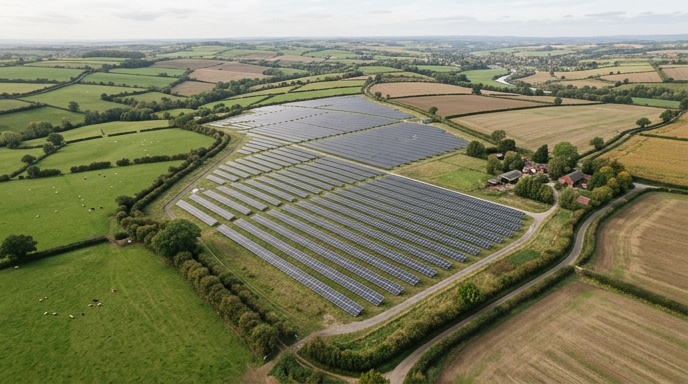
A solar farm in Ireland needs roughly 4 to 6 acres per megawatt of installed capacity. The exact figure depends on panel efficiency, row spacing to avoid shading, and whether the ground is flat. A 5 MW project, a common size for Irish developments, works out at around 20 to 30 acres.
Land use is driven by a few practical factors on Irish sites.
- Row spacing has to allow for the low winter sun, so panels aren’t shading the row behind them.
- Sloping or awkward fields reduce usable area and raise mounting costs.
- Boundaries, hedgerows, and biodiversity buffers trim the total further.
- Access roads and the substation compound take their own footprint.
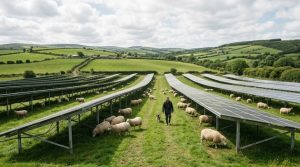
Agricultural land is the usual choice, and many projects allow sheep grazing between and under the rows. That dual use, often called agrivoltaics, keeps the land productive while it generates power.
What Does It Cost to Build a Solar Farm in Ireland?
Building a solar farm in Ireland typically costs in the region of €700,000 to €900,000 per megawatt, so a 5 MW project lands roughly between €3.5m and €4.5m. Costs have fallen over the past decade as panel prices dropped, though grid connection and civil works can swing the figure.
The main cost components break down like this.
| Cost Component | Share of Budget |
|---|---|
| Panels and inverters | Largest single share |
| Mounting and civil works | Varies with ground conditions |
| Grid connection | Highly site-specific |
| Design, planning, legal | Smaller but essential |
Grid connection is the wildcard. A site near existing network capacity costs far less to connect than one needing new infrastructure. Always get a connection cost indication early, because it can make or break a project’s return.
Is a Solar Farm Cheaper Than a Rooftop System?
Per megawatt, a solar farm is usually cheaper to build than a rooftop system because of scale and simpler ground-level access. The trade-off is land cost, grid connection, and a far longer planning and development timeline, which rooftop systems largely avoid.
How Much Electricity Does a Solar Farm Produce?
A 1 MW solar farm in Ireland generates around 950,000 to 1,100,000 kWh per year, enough to power roughly 200 to 250 average homes annually. Output depends on location, panel orientation, and how clear the local weather tends to be, with the sunnier south-east performing better than the north-west.
Irish output is lower than southern Europe, but the technology still performs well here. A few things lift the yearly figure.
- South-facing panels at an optimal tilt capture the most light over the year.
- Bifacial panels generate from both faces, picking up reflected light off the ground.
- Good maintenance keeps performance from drifting down over time.
- Cooler Irish temperatures actually help panel efficiency compared to very hot climates.
Over a 25-year lifetime, a well-sited megawatt can deliver well over 20 million kWh, with a gradual, predictable decline in output each year.
What Planning and Grid Approval Does a Solar Farm Need?
A solar farm in Ireland almost always needs full planning permission from the local authority, and larger projects may require an Environmental Impact Assessment. On top of that, you need a grid connection offer from ESB Networks or EirGrid before the project is viable.
The process runs in parallel but each stage has its own timeline.
- Planning permission covers visual impact, biodiversity, flooding, and traffic during construction.
- An EIA may be triggered on larger or sensitive sites, adding time and cost.
- A grid connection offer sets out where you connect and what you pay toward network upgrades.
- Landowner agreements, often long leases, need to be locked in before investment.
You can read the current national direction in the government’s climate and energy policy, which sets renewable targets that solar farms help meet. Grid connection in particular is a known bottleneck, so a realistic timeline is often two to four years from idea to energised.
Is a Solar Farm Right for Your Business?
A solar farm suits a business with spare land, patience for a long development timeline, and the appetite for a sizeable upfront investment or power purchase agreement. For most businesses, a right-sized rooftop or ground-mount system on their own site delivers faster savings with far less planning complexity.
Here’s how to think about which path fits.
- Large landholding and strong grid access nearby point toward a utility-scale farm.
- A big roof or unused yard with high daytime electricity use suits a commercial self-consumption system.
- High energy bills and a quick payback target favour building on your own demand.
- Commercial systems can tap the commercial solar grant under the SEAI scheme, which solar farms selling to the grid generally cannot.
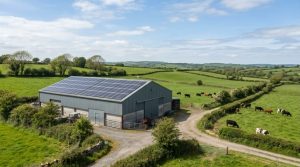
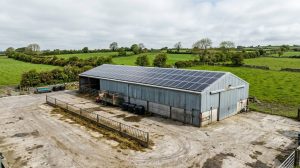
Agricultural landowners often weigh both, and farm-mounted solar on sheds frequently beats a full farm on return. You can see the sector-specific angle on solar for farming and agriculture, where self-consumption usually wins over exporting power.
The headline numbers are clear. Roughly 4 to 6 acres and €700,000 to €900,000 per megawatt, producing around a million kWh a year, over a two to four year development path. The devil is in the grid connection and planning detail.
If you’re weighing a solar farm against a commercial system on your own site, book a free site survey and consultation and our engineering team will tell you honestly which route gives you the better return.