Commercial battery storage lets a business store electricity and use it when it matters most, cutting peak demand charges and keeping critical equipment running during a grid outage. The two jobs it does best are peak shaving (trimming your most expensive demand spikes) and backup (bridging the gap when the power drops).
For most Irish businesses paying around €0.23/kWh, a battery on its own rarely pays for itself. Paired with a commercial solar system, though, it changes the maths. It soaks up daytime generation you can’t use straight away, then releases it during evening peaks or when the grid fails.
Below we break down how each function works, what it saves, and when a battery earns its keep on a commercial site.
What Is Commercial Battery Storage and How Does It Work?
Commercial battery storage is a large-scale energy storage system, often called a BESS (battery energy storage system), that charges when electricity is cheap or plentiful and discharges when it’s expensive or unavailable. It sits between your supply, your solar array and your loads, managed by software that decides when to store and when to release.
The core parts are straightforward:
- The battery modules that hold the charge, usually lithium iron phosphate for commercial sites.
- An inverter that converts between DC storage and AC power your building uses.
- A control system that watches your demand, tariff and solar output in real time.
On a site with commercial solar, the battery captures surplus generation at midday and holds it for the evening. On a site without solar, it charges from the grid during cheaper night-rate periods and discharges during costly peaks.
How Does Peak Shaving Cut Commercial Energy Bills?
Peak shaving reduces the highest points of your electricity demand by discharging the battery during those spikes, so you draw less from the grid when it’s most expensive. Many commercial tariffs charge not just for the energy you use but for your maximum demand in any period, so flattening those peaks directly lowers what you pay.
Why Peak Demand Charges Hurt Commercial Sites
Peak demand charges are billed on the single highest amount of power you pull at once, measured in kVA or kW, not your total consumption. A cold store that fires up several compressors together, or a factory that starts heavy machinery at 8am, can set a costly peak that follows the bill for a full billing period.
How a Battery Flattens the Demand Curve
The battery watches your live demand and discharges the moment it approaches your set threshold, topping up the grid supply so the meter never sees the full spike. When demand drops, it recharges quietly in the background. For sites with predictable daily surges, this shaves the peak reliably day after day.
- Reduces maximum demand (MIC) charges on commercial tariffs.
- Lets you run high-draw equipment without triggering a new demand peak.
- Works best where load spikes are sharp, short and repeatable.
The savings depend on your tariff structure and how spiky your load is, so a proper site assessment is the only way to know your number. A logistics depot or manufacturing plant with sharp morning surges typically sees far more benefit than a steady, flat-load office.
How Does Battery Backup Protect Critical Business Operations?
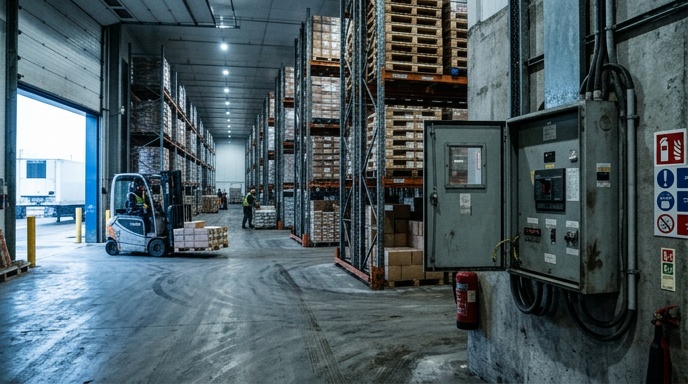
Battery backup keeps essential equipment powered when the grid fails, switching over fast enough that critical systems stay live. For a hospital ward, a data centre, a cold store or a food producer, even a short outage can mean spoiled stock, lost data or a safety risk, and a battery bridges that gap.
Backup differs from a diesel generator in a few ways that matter on a commercial site:
- It responds in milliseconds, so sensitive loads don’t see the interruption.
- It runs silently with no fuel, fumes or on-site storage.
- It can pair with solar to extend runtime during a longer outage.
How long a battery holds a site up depends on its capacity and the load it’s carrying. A backup sized for a whole factory is a very different job from one covering only refrigeration and safety lighting, which is why designers ring-fence critical loads onto a protected circuit. That keeps the backup focused on what truly can’t go dark.
When Does Battery Storage Make Financial Sense for Business?
Battery storage makes the strongest financial case when it’s paired with commercial solar and the site has either high peak demand charges or a genuine need for backup. On its own, charging and discharging from the grid, the margins are thin at current Irish electricity prices. Alongside solar, the battery stops you exporting cheap surplus and reselling grid power at full rate in the evening.
The factors that move the payback are worth checking before you commit:
- Your tariff, especially whether you pay separate maximum demand (MIC) charges.
- Your load shape, how sharp and predictable your daily peaks are.
- Whether you already have or plan solar generation to charge the battery cheaply.
- The value you put on uptime, which is high for cold chain, healthcare and data.
Storage also supports load shifting, storing daytime solar to use after dark, which raises how much of your own generation you actually consume. The more of your solar you use on site rather than export, the faster the whole system pays back.
It’s worth reviewing the current SEAI business energy supports when you build the business case, since capital allowances can shift the numbers.
Pairing Storage With Commercial Solar
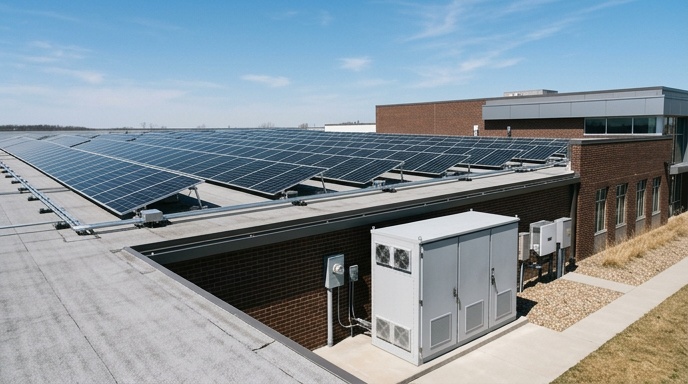
Storage and solar work best together because the battery captures generation your building can’t use in real time and releases it when the sun’s down.
This is where load shifting and peak shaving overlap, and where an engineered design earns its money by sizing the battery to your actual consumption pattern.
What Battery Storage Suits Different Commercial Sectors?
Different sectors get value from battery storage in different ways, so the right system depends on what your operation actually needs.
A cold store prizes backup for the cold chain, a factory chases peak shaving on heavy machinery, and a logistics depot leans on load shifting to feed daytime solar into evening EV charging.
| Sector | Main storage benefit |
|---|---|
| Cold storage | Backup for refrigeration, protecting stock during outages |
| Manufacturing and factories | Peak shaving on high-draw machinery start-ups |
| Logistics and warehouses | Load shifting to power evening EV fleet charging |
| Hospitals and healthcare | Fast backup for critical care and safety systems |
| Hospitality | Peak shaving and backup for kitchens and guest amenities |
For sites planning to electrify a fleet, storage becomes even more useful. Daytime solar can be banked and then released overnight to top up vans and lorries, which is where storage and commercial EV charging start to work as one system.
If your operation runs cold, our approach to solar for cold storage shows how generation and backup combine to protect refrigeration around the clock.
What to Check Before Installing Commercial Battery Storage
Before installing commercial battery storage, get a site assessment that measures your real load shape, tariff structure and available space, because a battery sized on guesswork either wastes money or falls short.
The design should match capacity to your genuine peaks and backup needs, not a generic package.
A few practical checks worth running early:
- Confirm your tariff and whether you pay separate maximum demand charges.
- Have your half-hourly consumption data pulled so peaks are measured, not estimated.
- Check available floor or plant space and ventilation for the battery enclosure.
- Ask about warranty, cycle life and long-term maintenance, not just the upfront cost.
If storage is part of a wider move to cut energy costs, book a free site survey so the design is built around your actual load, not a spec sheet. You can arrange a commercial consultation and get a system sized to your peaks, your backup needs and your solar plans.